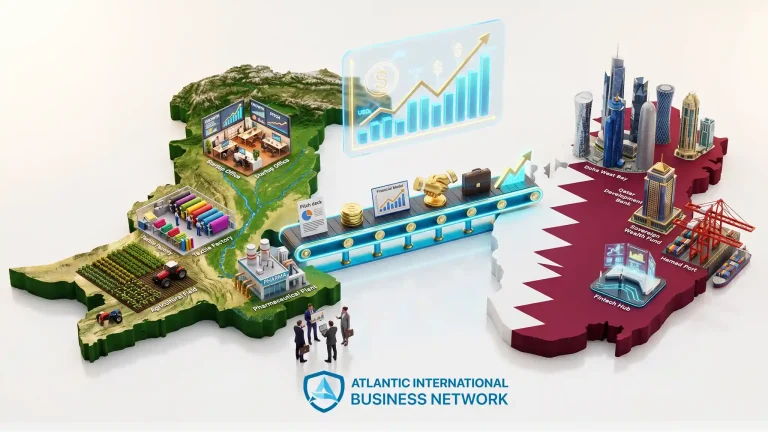



From vendor to strategic partner: a complete guide for Pakistani businesses entering Qatar’s market aligned with Vision 2030 goals. Covers sector strategies, ICV compliance, QFZA setup, and regulatory roadmaps for sustainable growth.
Quick Navigation
Introduction: Why 2026 Changes Everything for Pakistani Businesses in Qatar

For Pakistani exporters, 2025 was the turning point. Qatar’s economy is no longer in “construction mode”—it is in strategic diversification mode. According to the International Monetary Fund’s October 2025 outlook, Qatar’s economy is projected to grow at 2.9% in 2025 and accelerate to 6.1% in 2026, driven by the Third National Development Strategy (NDS3) that prioritises non-hydrocarbon sectors across technology, healthcare, logistics, and food security.
But here is what most Pakistani business owners do not realise: the rules of engagement have fundamentally changed.
Where once a product shipment and a price quote sufficed, Qatar now demands something different. The state actively measures whether your business helps achieve its national goals—as defined by Qatar National Vision 2030. This is not bureaucratic theatre. It is embedded in every government tender, every private-sector partnership framework, and every major procurement decision.
For Pakistani businesses—whether you manufacture surgical instruments in Sialkot, build software in Lahore, or export basmati rice from the agricultural heartland—this shift presents a critical choice:
Remain a transactional vendor, competing solely on price against Asian and European suppliers—or align with Vision 2030 and become a strategic partner with preferential access to multimillion-dollar contracts.
Explore AIBN’s strategic positioning services for Qatar market entry and discover how to make that transition with confidence.
What is Qatar National Vision 2030?
Qatar National Vision 2030 (QNV 2030) is the government’s long-term strategic framework launched in October 2008 to transform the nation into an advanced, knowledge-based economy. It encapsulates Qatar’s developmental aspirations to “build the homeland and the citizen” under four interconnected pillars: Human Development, Social Development, Economic Development, and Environmental Development.
It is not theoretical—it is operational. Every major government decision, budget allocation, and procurement priority flows through this framework.
The Four Pillars Explained
1. Economic Development: Moving beyond hydrocarbon dependency to build a diversified, competitive knowledge-based economy through innovation and private-sector growth.
2. Human Development: Investing in world-class education, healthcare, and workforce development to build a capable Qatari population.
3. Social Development: Preserving Islamic and cultural values while fostering social cohesion, family structures, and community resilience.
4. Environmental Development: Balancing economic growth with environmental sustainability through carbon-neutrality commitments and circular-economy practices.
As the Amir stated: “The Qatar National Vision 2030 builds a bridge between the present and the future. It envisages a vibrant and prosperous country in which there is economic and social justice for all, and in which nature and man are in harmony.”
The Pakistan–Qatar Economic Opportunity: By the Numbers
The 2025–2026 Moment
Qatar’s transformation is no longer aspirational—it is delivering real budget allocations:
- USD 17 billion allocated in 2025 for major non-oil projects (USD 6B for health, USD 5.3B for education, USD 6B for municipal development)
- USD 150+ billion non-oil project pipeline through 2030 (S&P Global Market Intelligence)
- Non-oil sectors now comprise 65% of Qatar’s GDP (up from 40% in 2015)
- Foreign investment grew 109.6% in 2024, with 12,400+ new foreign company registrations (a 600% year-on-year jump)
- USD 3 billion Qatar Investment Authority commitment to Pakistan across technology, healthcare, agriculture, and infrastructure
What This Means for Pakistani Exporters
Every dollar Qatar spends creates downstream demand. When the government allocates USD 6 billion for healthcare modernisation, it creates demand for medical equipment, surgical instruments, pharmaceuticals, and IT infrastructure. When it invests in smart cities and digital transformation, it needs software solutions, cybersecurity, cloud computing, and training services.
Pakistan is uniquely positioned to capture significant portions of this demand—but only if businesses understand how to position themselves through a structured Qatar market entry strategy.
Part 1: The Tawteen (Localisation) Factor — Understanding In-Country Value (ICV)
This is the single most important concept for Pakistani exporters to understand, and most do not.
Tawteen is Qatar’s localisation programme that prioritises suppliers who demonstrably add value locally. It is not voluntary—it is built into tender scoring, contract preferences, and government procurement frameworks.
What Is In-Country Value (ICV)?
ICV measures the percentage of a contract’s value that benefits the Qatari economy through:
- Local employment creation (Qatari and expatriate workforce hired in Qatar)
- Local supply chain development (purchasing from Qatari or Qatar-based suppliers)
- Training and knowledge transfer (building capability in the local workforce)
- Capital investment in Qatar (equipment, facilities, R&D centres established locally)
- Technology transfer and innovation (IP development that remains in Qatar)
The ICV Advantage for Pakistani Businesses
Led by Qatar Energy and now extended across government and major private-sector corporations, ICV scoring can make the difference between winning and losing multimillion-dollar contracts. A company offering a 35% ICV score holds a structural advantage over a company offering 15%, even if the latter has a lower price.
Real Example: Two software companies bid for a USD 5 million digital transformation project:
| Metric | Company A (Low ICV) | Company B (High ICV) |
|---|---|---|
| Price Quote | USD 4.2M | USD 4.8M |
| Local Value Promised | 10% (mostly staffing) | 40% (office, Qatari staff, tech transfer) |
| Tender Score | 62/100 | 78/100 ✓ WINS |
Company B wins despite the higher price because it aligns with Vision 2030 goals.
How Pakistani Businesses Increase ICV Scores
For a Pakistani software house or manufacturing firm, the five proven steps are:
- Establish local presence in Qatar (via the Qatar Free Zones Authority—see Part 2 below)
- Hire and train Qatari nationals in critical roles
- Partner with local Qatari suppliers and distributors wherever possible
- Develop IP and training programmes in Qatar that build local capability
- Document ICV contributions comprehensively in every tender response
Companies that apply this systematically win 2–3× more contracts than those that do not. Learn how AIBN’s ICV optimisation consulting maximises your tender scores.
Part 2: The Qatar Free Zones Authority (QFZA) — Your Gateway to Local Presence
One of the most underutilised tools available to Pakistani businesses is the Qatar Free Zones Authority, and setting up here is far more accessible than most exporters realise.
What Is QFZA?
QFZA operates three free-zone locations:
- Ras Bufontas Free Zone — adjacent to Hamad International Airport
- Umm Al Houl Free Zone — adjacent to Hamad Port
- Industrial zone in Lusail
The QFZA Advantage for Pakistani Businesses
If your current model involves flying sample shipments to Qatar and hoping for deals, you are operating at a significant disadvantage. QFZA removes that barrier entirely:
| Benefit | Impact for Pakistani Business |
|---|---|
| 100% Foreign Ownership | Pakistani business owns the entire operation—no Qatari partner required |
| 0% Corporate Tax (20 years) | 20-year tax holiday on profits generated in the zone |
| Zero Customs Duties | Import raw materials or products duty-free; re-export freely |
| Streamlined Registration | 2–4 weeks to establish a legal entity |
| Full Bid Eligibility | Qualify for government tenders requiring “local presence” |
| Logistics Access | Direct access to Hamad Port (world’s #3 most efficient) and Hamad Airport (160+ destinations) |
Strategic QFZA Uses for Pakistani Exporters
Pakistani IT and Software Companies
Establish a QFZA office as your regional headquarters. Hire 5–8 Qatari and expatriate staff. Then bid for government digital transformation contracts as a “local” company—dramatically increasing your ICV scores and tender qualification. Read about structuring joint ventures with Qatari technology partners.
Sialkot Surgical Instrument Manufacturers
Set up a QFZA distribution and quality-assurance centre. Maintain local inventory. Build direct relationships with Hamad Medical Corporation and private clinics. Attend trade shows and B2B events as a Qatar-based supplier rather than a visiting Pakistani exporter—the credibility difference is enormous.
Textile and Manufacturing Exporters
Operating from a QFZA location gives you access to Qatar’s preferential procurement frameworks for Vision 2030-aligned suppliers. Your products become “Qatar-sourced” for supply-chain purposes, opening corporate and government contracts that would otherwise be inaccessible.
Cost Estimate for a Pakistani SME
Establishing a basic QFZA office typically costs USD 8,000–15,000 (initial setup) plus USD 2,000–4,000 per month in operating costs. ROI is usually achieved within 6–12 months via the first major contract secured. Commission a QFZA feasibility study to validate the numbers for your specific business.
Part 3: Mapping Your Business to Vision 2030 — The Four Strategic Pillars

To win in Qatar’s market, you must answer one fundamental question: how does my business help Qatar achieve its national goals? The answer lies in identifying which of the four pillars you serve—and then making that alignment unmistakably clear in every pitch, tender, and partnership conversation.
Pillar 1: Economic Development — The Tech & Innovation Sector

Qatar’s Need: Transforming into a knowledge-based economy through digital innovation, FinTech, EdTech, and smart-city development.
Pakistani Opportunity: Pakistan produces approximately 25,000–30,000 computer-science graduates annually, with over 276,000 students enrolled in ICT programmes. Pakistani software houses compete at international standards across:
- AI and machine-learning applications
- Cloud computing and infrastructure
- Cybersecurity solutions
- Custom software development and system integration
- EdTech platforms and digital learning solutions
Strategic Approach for Tech Companies
- Transition from freelance to entity-based: Stop bidding as individuals on freelancing platforms. Establish a formal company structure.
- Create a QFZA presence: Use it as your regional headquarters for government and corporate bidding.
- Develop Vision 2030-aligned offerings: Not just “custom software”—position as “Digital Transformation Partner for Smart Cities” or “AI-Powered Government Services Platform.”
- Partner with Qatari entities: Form strategic alliances with local firms that understand government procurement cycles.
- Invest in certifications: ISO 27001 (Information Security), SOC2 compliance, and sector-specific government security clearances.
Success Model: In November 2025, Pakistan’s IT Minister Shaza Fatima Khawaja met with Qatar Development Bank (QDB) CEO Abdulrahman Al Sowaidi to formalise technology partnerships. For B2B SaaS companies targeting GCC government clients, Qatari ministries and government-linked entities prefer contracting with mainland-registered companies or entities with local presence, making a QFZA-based entity the optimal structure.
Actionable Next Step: Schedule a call with Qatar Development Bank or Qatar Science & Technology Park, and reference the Pakistan–Qatar bilateral IT collaboration framework when you do.
Pillar 2: Human Development — Healthcare & Medical Supplies

Qatar’s Need: Developing a comprehensive, world-class healthcare system equipped with advanced medical equipment, high-quality pharmaceuticals, and modern healthcare infrastructure.
Pakistani Opportunity: Sialkot’s surgical instrument industry is a global powerhouse. Pakistan supplies between 20–70% of the world’s surgical instruments (estimates vary by instrument type), and the industry generated USD 1.8 billion in exports in 2024—up from USD 1.5 billion in 2023—reaching over 140 countries.
For Qatar specifically, three factors create immediate demand:
- Hamad Medical Corporation is modernising: New clinics, surgical centres, and hospitals require cutting-edge instruments at scale.
- Cost-effectiveness matters: Qatar demands world-class quality but welcomes Pakistani suppliers who meet international standards (ISO 13485, CE marking, FDA registration).
- Bilateral healthcare agreements: The October 2025 Pakistan–Qatar Joint Ministerial Commission established mutual recognition frameworks for pharmaceuticals and medical devices, substantially reducing regulatory burden.
Regulatory Pathway for Sialkot Manufacturers
The mutual recognition protocol established in October 2025 has streamlined the process significantly:
- DRAP (Drug Regulatory Authority of Pakistan) Certification — your existing documentation applies
- Qatar Ministry of Public Health Mutual Recognition — new fast-track process now active
- Hamad Medical Corporation Vendor Registration — now includes Pakistani manufacturers under the bilateral framework
- Timeline: 3–4 months from application to first purchase order (down from 9–12 months previously)
Pharmaceutical Opportunity
Qatar has rising healthcare costs and actively seeks high-quality generic medicines. Pakistani pharmaceutical manufacturers with WHO-GMP certified facilities are well-positioned to fill this gap. The bilateral mutual recognition specifically addresses pharmaceutical registration—this is a first-mover advantage that will not last indefinitely. Review export compliance requirements for medical products entering the GCC.
Pillar 3: Environmental Development — Green Supply Chain
Qatar’s Need: Carbon-neutral operations and sustainable supply chains aligned with World Cup commitments and circular-economy principles.
Pakistani Opportunity: Sustainable textile manufacturing, eco-certified construction materials, and environmental compliance solutions are all in demand.
Key Requirement: GORD (Gulf Organisation for Research and Development) standards are now mandatory for many product categories. Products that lack environmental compliance are rejected at Hamad Port customs—without exception. For Pakistani textile manufacturers, adopting the following certifications is no longer optional:
- GOTS (Global Organic Textile Standard)
- Waterless or low-water dyeing processes
- Recycled material sourcing
- ISO 14001 (Environmental Management)
Qatar’s hospitality sector is growing at 13.4% year-on-year (Q2 2025). That growth creates consistent procurement demand for sustainable linens, uniforms, and furnishings—making green compliance a revenue driver, not just a cost.
Pillar 4: Social Development — Food Security & Agricultural Partnerships

Qatar’s Need: Food security with 55% self-sufficiency in fresh vegetables and 70% in table eggs by 2030, as defined by the National Food Security Strategy 2030.
Pakistani Opportunity: Pakistan serves as a natural agricultural partner for the Gulf. Key exports include basmati rice, halal meat, fresh produce, and dairy products. Geographic proximity (a 3–4 hour flight) enables fresh delivery, while cultural alignment means halal certification is effectively automatic.
To move from spot market sales to long-term supply agreements, Pakistani exporters should:
- Secure multi-year supply agreements with major Qatari distributors and retailers such as Carrefour, Lulu Hypermarket, and Spinneys
- Implement end-to-end traceability systems — cold-chain logistics, HACCP certification, and ISO 22000 compliance
- Pursue direct B2B contracts with government food procurement authorities participating in Qatar’s food security initiatives
Exporters who position on reliability and traceability consistently secure multi-year supply contracts at premium prices. Learn how AIBN brokers distribution agreements to establish retail partnerships in Qatar.
Part 4: Regulatory Complexity & Certification Roadmap
Many Pakistani business owners arrive in Doha underprepared for Qatar’s regulatory requirements. This section maps precisely what is needed by sector so you can plan your timeline and budget before you travel.
Common Certifications Required by Qatar
Cross-Sector (All Industries)
- ISO 9001:2015 (Quality Management)
- English-language documentation (Arabic increasingly required for government contracts)
Healthcare / Medical Devices
- ISO 13485 (Medical Device Quality Management)
- CE Marking (EU Directive compliance — Qatar recognises this)
- FDA Registration (where applicable)
- DRAP certification (Pakistan)
- New: Qatar Ministry of Public Health mutual recognition (October 2025 protocol)
Pharmaceuticals
- WHO-GMP (World Health Organization Good Manufacturing Practice)
- DRAP certification
- New: Mutual recognition under the October 2025 bilateral protocol
Textiles / Apparel (Eco-Focus)
- GOTS (Global Organic Textile Standard)
- ISO 14001 (Environmental Management)
- GORD certification (Gulf Organisation for Research and Development)
Food / Agriculture
- HACCP (Hazard Analysis and Critical Control Points)
- ISO 22000 (Food Safety Management)
- Halal certification (if applicable)
- Phytosanitary certificates (for fresh produce)
Software / IT Services
- ISO 27001 (Information Security Management)
- SOC2 Compliance (if handling sensitive data)
- ISO 9001:2015 (Quality Management)
Timeline and Cost Estimates
Regulatory compliance typically takes 3–6 months and costs USD 5,000–25,000 depending on your sector and current certification status. Starting this process early—ideally before your first Qatar sales trip—eliminates the most common cause of deal collapse: being unable to produce documentation when a buyer is ready to commit.
Access AIBN’s legal and compliance framework guidance tailored to your sector.
Part 5: Your Vision 2030 Readiness Assessment
Use this four-phase self-assessment framework to determine where you stand—and what you need to do before investing in Qatar market entry.
Phase 1: Capability Audit
- What is my product or service’s competitive advantage versus regional and global competitors?
- Do I hold internationally recognised quality certifications? (If not, this is Priority #1.)
- What is my annual production or service capacity?
- Have I previously exported to Gulf markets? (If yes, document the lessons.)
- Which certifications am I currently missing for Qatar market entry?
Phase 2: Pillar Alignment
Determine which Vision 2030 pillar or pillars your business supports:
- Economic Development — tech, innovation, knowledge services
- Human Development — healthcare, education, training, workforce development
- Social Development — food, culture, community services
- Environmental Development — sustainable products, green solutions
Most businesses align with one or two pillars. That alignment is your positioning angle—build every message around it.
Phase 3: Gap Analysis
Identify the missing elements and assign a cost and timeline to each:
- Missing certifications? (Plan timeline and budget to obtain them.)
- No local presence in Qatar? (QFZA cost estimate: USD 8,000–15,000 setup + USD 2–4K/month operating.)
- No Qatari business partner or agent? (Build a targeted networking plan.)
- Regulatory knowledge gaps? (Engage local consultants: USD 3,000–8,000.)
Phase 4: Strategic Positioning
Develop your “Vision 2030 alignment narrative.” Compare these two versions:
Instead of: “We manufacture surgical instruments and export them globally.”
Try: “We are an ISO 13485-certified surgical instrument manufacturer supporting Qatar’s world-class healthcare vision—providing precision instruments at cost-effective rates, with the capacity to establish local inventory, train Qatari technicians on quality standards, and integrate with Hamad Medical Corporation’s procurement framework.”
The second version sells strategic value, not just a product. Work with AIBN to develop your complete Vision 2030 alignment narrative.
Part 6: Common Challenges & Mitigation Strategies

Challenge 1: Regulatory Complexity
The Problem: Qatar’s certification requirements are sector-specific and poorly documented for foreign suppliers, making it easy to invest months of effort in the wrong approval sequence.
The Solution: Engage specialist regulatory consultants before you begin the process. Budget USD 3,000–8,000 for a compliance audit and allow 3–6 months for initial approvals.
Challenge 2: “Cold Pitch” Scepticism
The Problem: Qatari businesses are risk-averse and strongly prefer suppliers with an established local footprint or credible local intermediaries. Unsolicited approaches from overseas suppliers are rarely acted upon.
The Solution: Never cold-pitch. Build relationships through:
- Industry associations (Qatar Chamber, sector-specific groups)
- Trade delegations organised through SIFC — Special Investment Facilitation Council
- Qualified local agents or distributors introduced by AIBN
- Attendance at B2B forums and trade shows
Challenge 3: Missed Incentive Programmes
The Problem: Many Pakistani exporters are unaware of the tax holidays, duty exemptions, and QFZA benefits available to Vision 2030-aligned businesses—and therefore never access them.
The Solution: If you are operating without a QFZA presence or formal local registration, you are leaving money on the table. Commission a QFZA feasibility study to quantify the opportunity for your specific business model.
Challenge 4: Working Capital and Performance Bonds
The Problem: Government and corporate contracts routinely require substantial working capital and performance bonds—often 5–10% of contract value—which can strain Pakistani SMEs.
The Solution: Explore financing through:
- Pakistani banks with Gulf operations (NBP, MCB, and HBL each have Doha branches)
- Qatar Development Bank (for technology and strategic sectors)
- QFZA-based financial institutions and AIBN’s capital-raising services
Challenge 5: Geopolitical Dynamics
The Problem: Regional developments can disrupt trade flows with limited warning, and businesses over-reliant on a single market are especially vulnerable.
The Solution: Diversify across multiple GCC markets from the outset and maintain flexible supply-chain strategies. Explore AIBN’s GCC expansion planning services to build resilience into your growth strategy.
2025–2026 Sector Opportunities — Where the Budget Is Flowing
Qatar allocated USD 17 billion for major projects in 2025 alone. Understanding where those funds are directed tells you precisely where procurement demand is most acute.
Healthcare Transformation (USD 6 billion)
New hospitals and specialised clinics are being built under NDS3, alongside digital-health infrastructure modernisation and large-scale medical equipment procurement. For Pakistani exporters, Sialkot surgical instruments, pharmaceuticals, and healthcare IT solutions all have immediate addressable demand.
Education and Digital Skills (USD 5.3 billion)
A National Skilling Programme is training 50,000+ people in digital skills, accompanied by EdTech platform development and university infrastructure expansion. Pakistani EdTech solutions, software platforms, and Arabic-language training services are directly relevant.
Infrastructure and Smart Cities (USD 6 billion municipal)
Lusail City expansion, smart-city IoT systems, and logistics infrastructure are all active procurement categories. Pakistani IT infrastructure suppliers, logistics-solutions providers, and construction-material exporters are well-positioned to compete.
Tourism and Hospitality Growth (13.4% YoY, Q2 2025)
Hotel and resort expansion is ongoing, as is event-management infrastructure development. Sustainable textile exporters, hospitality furniture suppliers, and food and beverage producers all have direct procurement pathways into this growing sector.
AIBN’s Qatar Market Services — Your Execution Partner
You now have the complete strategic framework. The remaining question is execution. AIBN has facilitated Pakistan–Qatar partnerships across tech, healthcare, agriculture, and manufacturing, and our clients secure contracts averaging 3–5 years in duration within 8–12 months of engagement.
Market Entry Planning
- Qatar and GCC market entry and expansion strategy — comprehensive planning from research to launch
- Qatar market feasibility studies — validate your opportunity before committing capital
- Competitive analysis for Qatar sectors — understand who you are competing against
- Vision 2030 strategic positioning development — build a compelling alignment narrative
Partnership and Joint Venture Services
- Joint venture formation in Qatar — establish the right local partnership structure
- Strategic alliance formation with Qatari entities — build relationships that last
- Distribution agreement brokering in Qatar — reach buyers through trusted channels
Regulatory and Compliance Services
- Qatar regulatory navigation services — sector-specific compliance guidance
- Trade policy advisory for GCC markets — stay ahead of regulatory change
- Legal compliance framework development — ensure you meet every requirement
- Regulatory risk identification and mitigation — protect your market position
Capacity Building and Training
- International negotiation training for GCC markets — master Qatari business culture and deal-making
- Cultural competency programmes for Qatar — build the relationships that underpin long-term contracts
Investment and Funding Services
- Investment advisory services for Qatar expansion — structure your entry for maximum return
- Capital raising services for GCC market entry — secure the financing you need to compete
Ready to Move Forward? Your Next Steps
Immediate Actions (Week 1)
- Complete the Readiness Assessment outlined in Part 5
- List your current certifications and identify the gaps
- Determine which Vision 2030 pillar or pillars align with your business
- Research QFZA costs for your specific industry and footprint
Month 1–2 Actions
- Engage regulatory consultants for sector-specific compliance pathways
- Develop your Vision 2030 alignment narrative
- Identify potential Qatari partners or agents
- Research relevant industry associations and trade delegations
Month 2–3 Actions
- Establish your QFZA entity (if applicable)
- Begin regulatory approval processes in parallel
- Make your first visit to Qatar specifically for relationship building
- Attend relevant trade shows or B2B procurement forums
The door to Qatar’s market has never been more open. But it opens fastest for those who understand the new rules.
Schedule your free Qatar market assessment — limited to 10 businesses per month
AIBN will help you determine which Vision 2030 pillar aligns best with your capabilities, your required certifications and regulatory pathway, your estimated timeline and investment for market entry, specific partnership opportunities currently available, and ICV optimisation strategies for your business model.
Additional Resources and Authority Links
Official Government Sources
- Qatar National Vision 2030 — Official Portal (Government Communications Office)
- National Planning Council — QNV 2030 Framework
- Qatar Free Zones Authority — Investor Resources
- Ministry of Foreign Affairs — QNV 2030
Business Opportunity and Investment Analysis
- U.S. Commercial Service — Qatar Market Opportunities (verified sector data)
- Newoon — Qatar Vision 2030 Business Opportunities 2026 (April 2026 analysis)
- National Vision 2030 Intelligence Platform — sector-by-sector analysis
Economic Data and Business Registration
- Qatar Central Bank — official economic data and statistics
- Qatar Chamber of Commerce and Industry — business registration and chamber services