


Thinking of expanding your Pakistani business to Qatar in 2026 but don’t know where to start? That moment of decision when you’re ready to jump into the lucrative Qatari market but feel overwhelmed by the paperwork is exactly what we tackle every day. Many of our clients start right where you are.
At AIBN, we’ve helped more than 19 Pakistani ventures launch successfully in the Pakistan GCC corridor, including Qatar. Here is a clear step by step guide to help your business grow safely, legally, and profitably.
1. Profitable Niches in Qatar 2026 Market
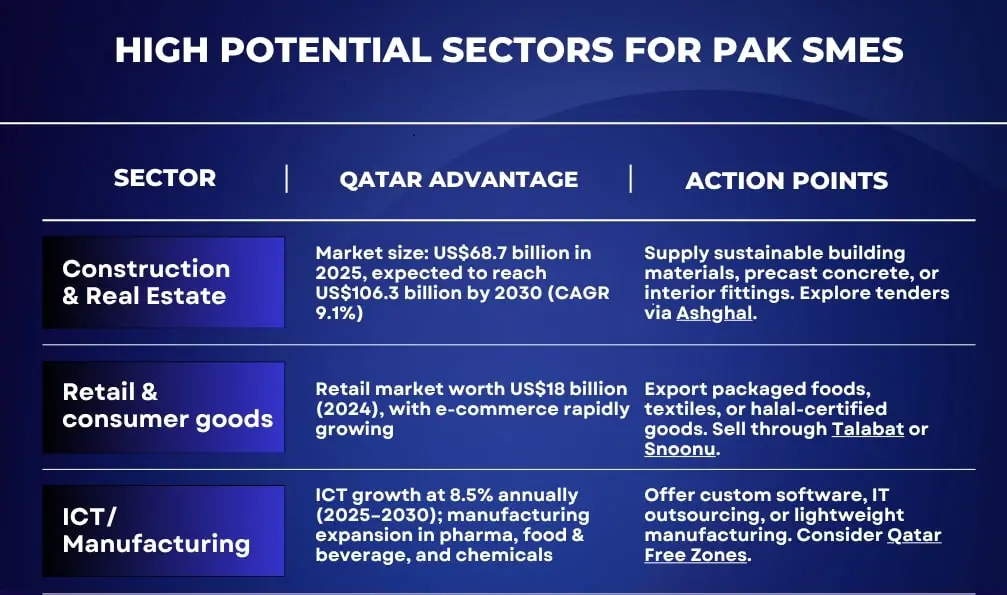
Qatar’s booming economy, fueled by strong bilateral trade, isn’t just offering opportunities in 2026 it’s actively seeking Pakistani SMEs across the GCC.
The table below shows key sectors where Pakistani SMEs can find best opportunities in Qatar’s 2026 economy along with the unique advantages and business openings in each. These sectors prove the rising SME opportunities in GCC economies, where Qatar remains one of the most business-friendly country.
Before getting into the legal matters, we must first answer the foundation question: What exactly should you sell? Let’s assess Qatar’s demand and your product fit.
2. Qatar Market entry in 2026: Product Fit and Export Potential
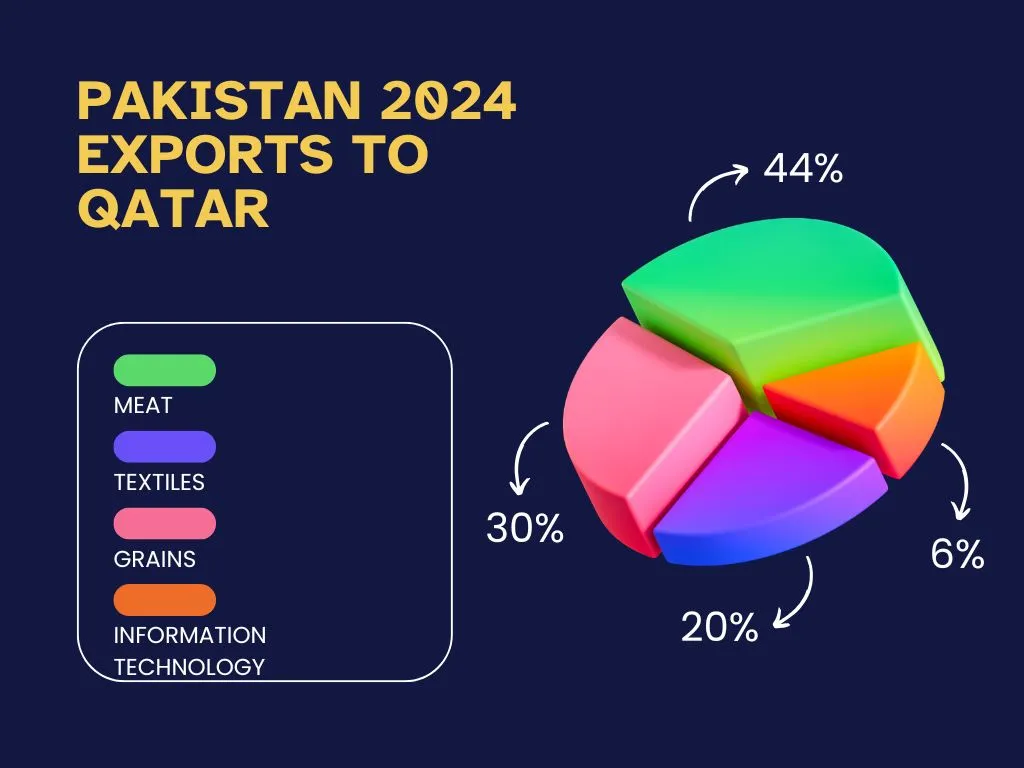
- Pakistan’s exports to Qatar (US$158 million) are mainly focused on key sectors which include meat, grains (like rice and maize) and textiles.
- A rapidly growing category is Information Technology, which saw exports grow to US$9.37 million (approximately 6% of total exports) between FY2023-FY2024.
With digital trade channels improving, export to Qatar from Pakistan is expected to continue its upward trajectory in 2026.
Start with high demand and low capital products like packaged foods, textiles, or IT services.
3. Legal and Company Setup: What Pakistani SMEs Need to Know
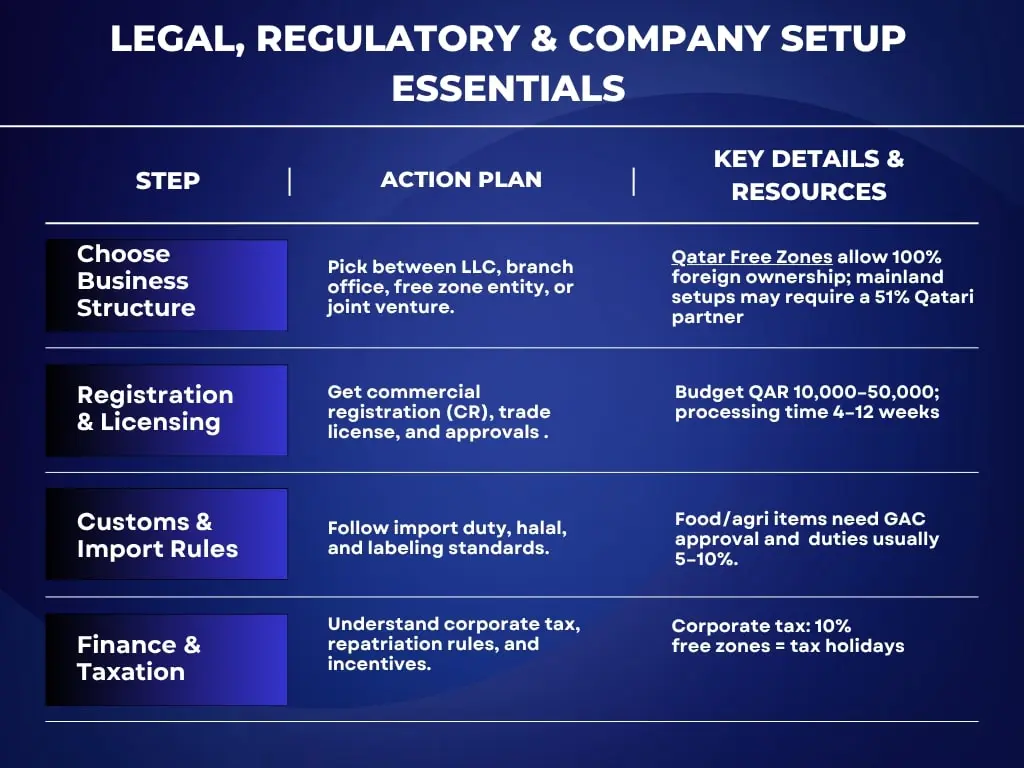
The structure you choose (LLC vs. Free Zone vs. Mainland) is the single most important decision, and it dictates your entire setup timeline. The following table breaks down each stage, what actions are needed, and which official resources you’ll rely on.
Official Source Links (Qatar)
- Ministry of Commerce & Industry (MOCI): For company registration, commercial licenses, and business regulations.
- Invest Qatar: For foreign investment rules, ownership laws, and setup guidance.
- Qatar Free Zones Authority: For free zone registration, incentives, and 100% foreign ownership
- General Authority of Customs (GAC): For import duties, halal/health certifications, and customs rules.
- Qatar Chamber of Commerce & Industry: for local business partnerships, PRO services, and trade support.
4. Timeline & Cost Estimate for Market Entry
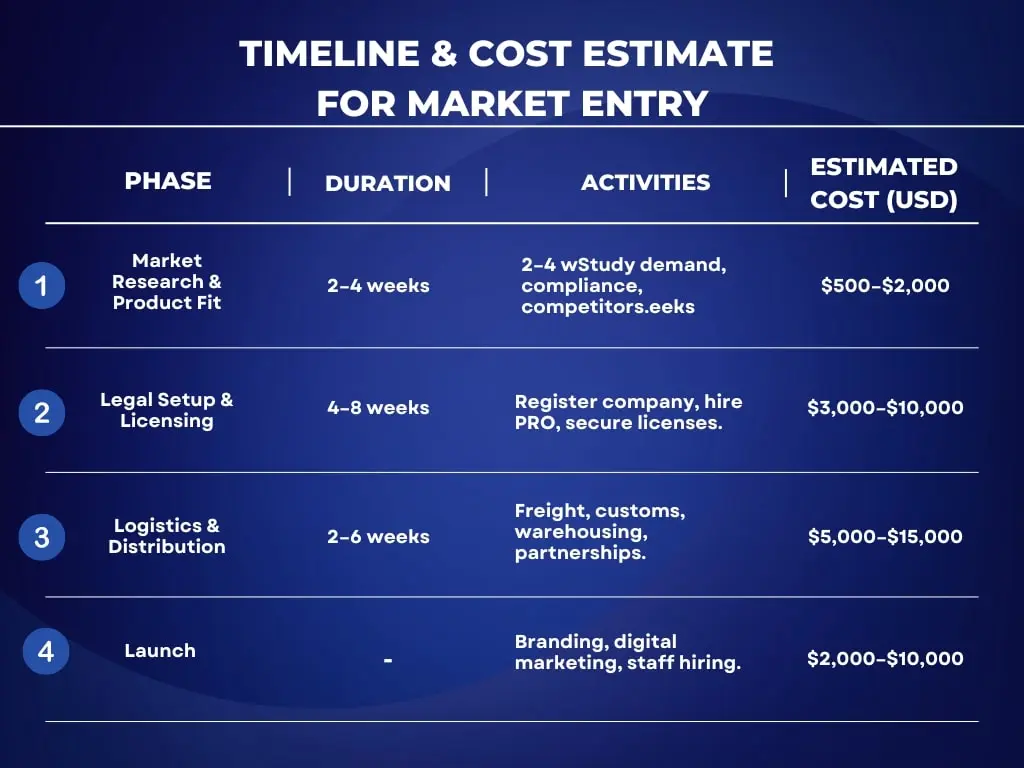
To help plan your entry efficiently, the table below presents an estimated timeline and cost range for each stage of establishing your business in Qatar.
5. Risks & Mitigation Strategies
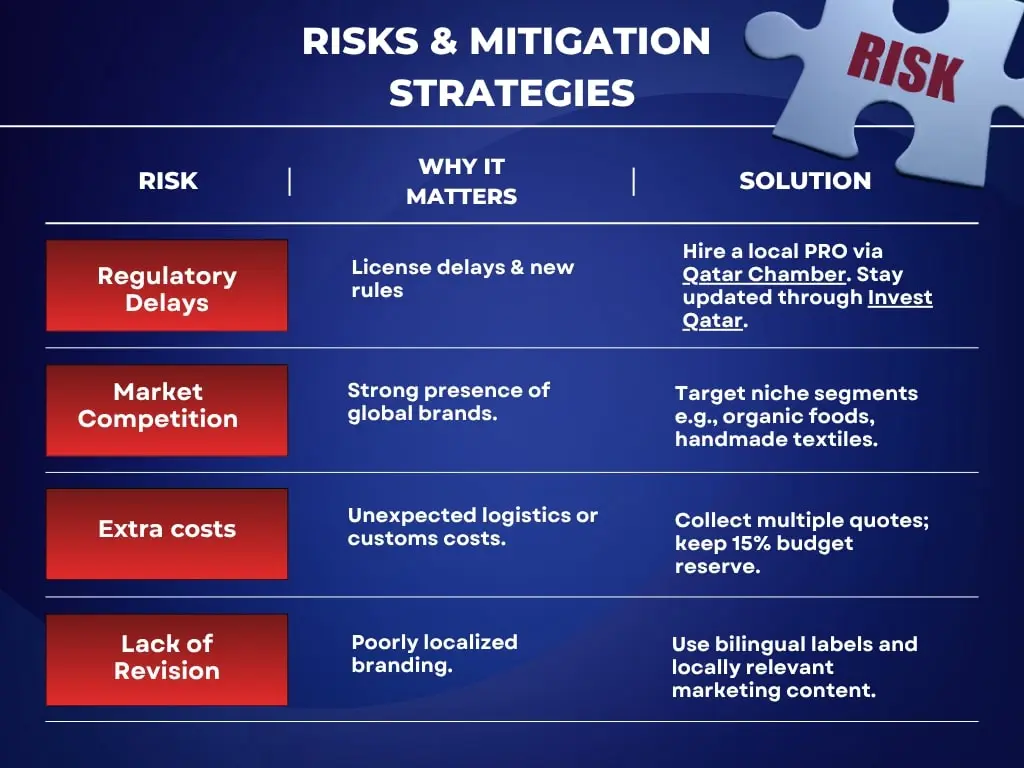
You can’t achieve success without managing the downside. Below is a realistic look at the top risks our Pakistani clients face in Qatar, along with proven mitigation strategies.
6. Pre-Launch Checklist
Below is a pre-launch checklist summarizing the critical steps to complete before officially entering the Qatar market.
- Analyze 5-year trade data via Qatar Trade Portal
- Confirm import standards with GAC
- Choose structure: Free Zone (QFZ) or mainland setup
- Prepare bilingual labeling and packaging
- Arrange logistics (Qatar Airways Cargo)
- Find a distributor (Talabat / Snoonu)
- Register and open a bank account (QNB)
- Build marketing via Visit Qatar insights
FAQs
What are the most profitable niches in Qatar for Pakistani SMEs in 2026?
The most promising sectors are Construction & Real Estate (a market expected to reach US$106.3 billion by 2030), Retail & Consumer Goods (worth US$18 billion), and ICT/Manufacturing (growing 8.5% annually).
What is the best legal structure for a Pakistani business to set up in Qatar?
You have two main options: Qatar Free Zones (QFZ) or a Mainland company. QFZs offer 100% ownership and tax holidays. Due to the Foreign Investment Law (Law No. 1/2019), Mainland companies also allow 100% ownership in most sectors like manufacturing, IT, consulting, and retail. However, some strategic sectors on the mainland (like banking or commercial agencies) are still restricted and require special approval.
What are the main products for export to Qatar from Pakistan?
Pakistan’s main exports to Qatar are focused on key sectors like meat, grains (such as rice and maize), and textiles. Information Technology (IT) services are also a rapidly growing export category.
What is the estimated cost to invest in Qatar for a new SME?
The total estimated cost to enter the Qatari market ranges from $10,500 to $37,000 USD. This covers initial market research, legal setup and licensing, logistics and customs, and the launch marketing.
What are the main risks for a Pakistani SME during Qatar market entry?
The top risks include regulatory delays from new rules, strong competition from global brands, unexpected logistics or customs costs, and a lack of localization in branding or packaging.
Conclusion
The most important takeaway is this: Qatar’s 2026 economy is ready to welcome Pakistani SME talent, particularly in the high growth sectors like construction, retail, ICT, and manufacturing.
Success depends on:
- Using real data to target the right niche.
- Setting up legally and efficiently.
- Managing logistics smartly.
- Localizing your approach for Qatari consumers.
While official portals like Invest Qatar and the Qatar Chamber are excellent resources, navigating the setup process alone can be complex.
Ready to make your 2026 Qatar expansion a reality? Contact AIBN today. Our team has the on-ground experience to manage your legal setup, logistics, and market entry strategy from start to finish.