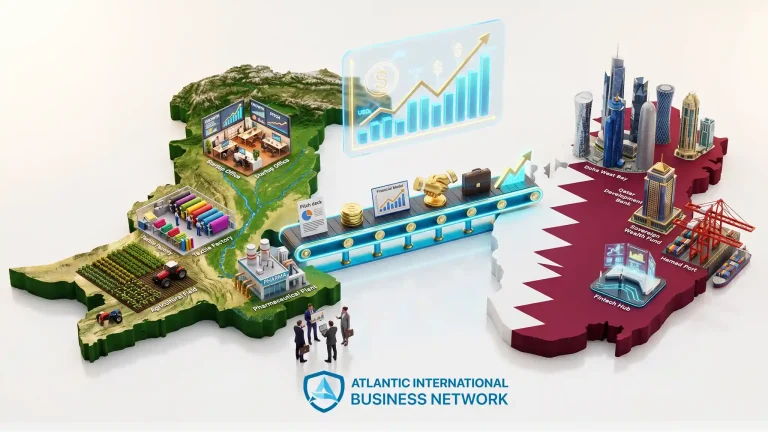


The Pakistan–Qatar bilateral trade relationship is finally moving from diplomatic language into real infrastructure. The 6th Joint Ministerial Commission (JMC) in October 2025 unlocked a $3 billion Qatar Investment Authority (QIA) commitment, activated the Joint Task Force, and launched direct Pakistan–Qatar cargo routes. This guide covers everything — routes, data, frameworks, and how to act on it.
The state of Pakistan–Qatar bilateral trade in 2026
For decades, Pakistan’s biggest export to Qatar was its people — remittances from Qatar reached USD 901.6 million in FY 2024. Trade in goods stayed thin. That’s changing now. Key 2025–26 developments are as follows:
- 6th JMC session (October 2025) — most concrete bilateral action in the commission’s history.
- QIA $3 billion investment pledge — channelled into agriculture, energy, real estate, and industry.
- Special Investment Facilitation Council (SIFC) — activated as Pakistan’s single investment window.
- Qatar Vision 2030 — identifies Pakistan as its primary partner for food security & agricultural supply.
- Pakistan–Qatar Joint Task Force — launched to connect exporters with Qatari buyers directly.
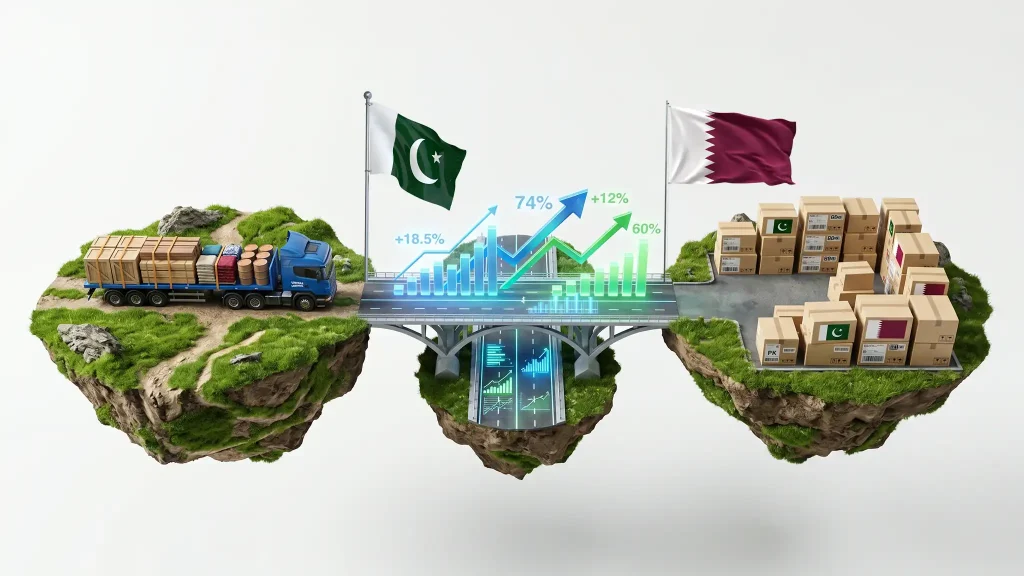
Pakistan–Qatar Trade Data and Statistics
| Trade Metric | Value |
|---|---|
| Total Bilateral Trade (FY 2024) | $3.69B |
| Pakistan Exports to Qatar (FY 2024) | $158.1M |
| Pakistan Imports from Qatar (FY 2024) | $3.53B |
| Remittances Qatar → Pakistan (FY 2024) | $901.6M |
| Financial Year | Exports (USD M) | Imports (USD M) | Total (USD M) |
| FY 2021 | 140.1 | 1,917.0 | 2,057.1 |
| FY 2022 | 192.7 | 3,576.3 | 3,769.0 |
| FY 2023 | 162.5 | 3,567.2 | 3,729.7 |
| FY 2024 | 158.1 | 3,531.4 | 3,689.5 |
Source: Federal Board of Revenue (FBR) Pakistan | MOFA Embassy of Pakistan, Doha
Over 95% of Pakistan’s imports from Qatar are petroleum gases and LNG — worth USD 3.36 billion in FY 2024. Diversifying exports is Pakistan’s most urgent bilateral priority.
Direct Trade Routes — How cargo moves
Sea freight: Karachi Port / Port Qasim → Hamad Port, Doha
- Pakistan Gulf Service (PGS) operates a dedicated direct route — no UAE rerouting.
- Transit time: 6–8 days vs. 9–13 days via UAE transshipment hubs.
- Hamad Port, managed by Mwani Qatar, handles millions of TEU container units annually.
- Eliminates UAE transshipment fees and port handling charges — better margins on bulk cargo.
Air freight: Karachi → Hamad International Airport
- Best for pharmaceuticals, perishables, and high-value goods.
- Temperature-controlled facilities available at Hamad International Airport.
- Bilateral aeronautical cooperation expanding in 2026 — cargo frequency & rates improving.
Gwadar Port — the emerging Gulf corridor
- Backed by the China–Pakistan Economic Corridor (CPEC) — a $64 billion infrastructure initiative.
- Container activity at Gwadar Port rose measurably in 2026; Russian ships arrived in early 2026.
- Shorter route to Gulf markets for exporters in western Pakistan and Central Asia-sourced supply chains.
Pakistan–Qatar Export Opportunities by Sector
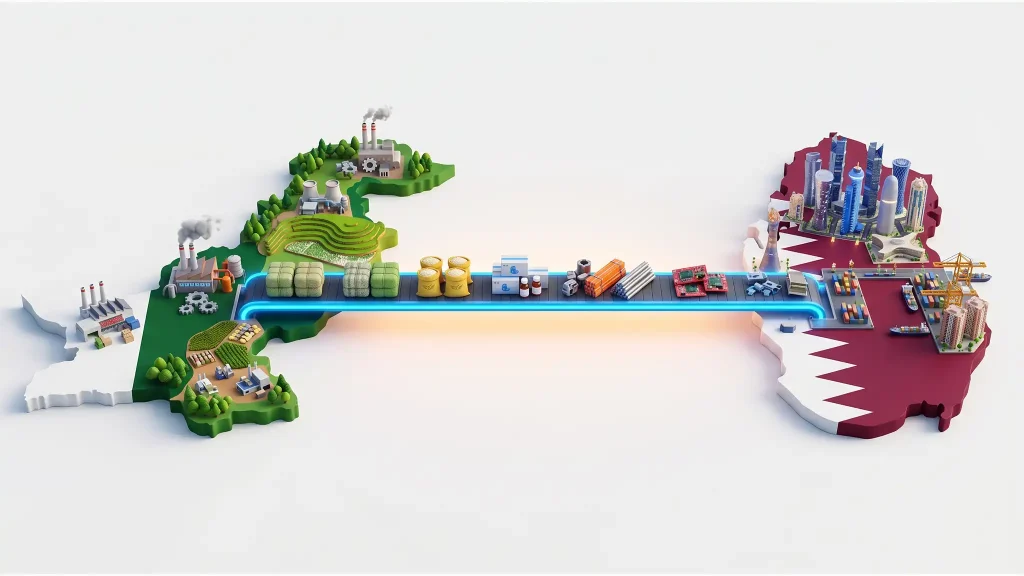
The Qatar Vision 2030 and food security policy generate demand in various categories of exports from Pakistan:
- Exports of halal food and agriculture products – basmati rice, fresh produce, onions (+7,326% in FY 2024), halal meat, maize, animal feed.
- Textiles and garments — finished garments with GSO compliance and Arabic-compliant labelling outperform raw fabric on margin and buyer retention.
- Construction materials — cement and steel; Qatar’s infrastructure pipeline remains active; Pakistan has invited Qatar to co-invest in domestic motorway projects.
- IT services and digital economy — Pakistani firms building Qatar client bases via the Pakistan–Qatar Science and Technology Park (QSTP) and STZA cooperation.
- Pharmaceuticals and medical goods — mutual recognition of standards under active discussion; the regulatory window is opening for Pakistani pharmaceutical exports to Qatar.
Pakistan Trade Corridors to Central Asia — The new frontier
Pakistan is simultaneously building alternative overland routes that reduce dependence on unstable Afghan transit routes and unlock Central Asia’s 70-million-strong consumer base.
The Iran Corridor — Operational since April 2026
- Gabd–Rimdan border crossing with Iran activated April 2026 — first shipment: frozen meat Karachi → Tashkent, Uzbekistan.
- Initial phase: $2–3 billion annually; long-term potential: $10–15 billion with full utilisation.
- Operates under the International Road Transport Union (IRU) framework; key crossings: Taftan, Rimdan, Sost, Gwadar.
- More reliable than Afghan transit routes — no informal levies, no sudden closures.
The China Corridor — Khunjerab Pass and QTTA
- First shipment from Kyrgyzstan reached Karachi via Khunjerab Pass and Sost Dry Port in April 2026.
- Quadrilateral Traffic in Transit Agreement (QTTA) — Pakistan, China, Kazakhstan, Kyrgyzstan — enables Afghan-free cross-border movement.
- Route to Bishkek: ~3,230 km via China — saves up to 3 days vs. Afghan route.
- Pakistan–Central Asia bilateral trade reached $2.41 billion in FY 2025, up from $1.92 billion — corridors are building on real momentum.
Logistics and Compliance — Documentation checklist
Missing one document can hold your cargo for days. For Pakistan–Qatar customs clearance, you need:
- Bill of lading
- Certificate of origin (attested)
- Commercial invoice and packing list
- Halal certification — mandatory for all food, meat and poultry; no exceptions
- GSO compliance certificate for regulated goods
- Arabic-compliant labelling for retail-bound products
- Phytosanitary certificate for fresh produce
Use a Gulf freight forwarding specialist — not a general logistics provider. The Qatar customs process has specific requirements that generalists frequently miss.
Common Qatar Market Entry Mistakes
| Challenge | How to avoid it |
| Quality & certification gaps | Get halal & GSO certification before committing to any shipment |
| Relying on UAE middlemen | Switch to the PGS direct route; build Qatari buyer relationships directly |
| Cold chain failures | Audit end-to-end; use Hamad Airport temperature-controlled facilities for perishables |
| No Qatar-specific market data | Commission a Qatar competitive analysis before first shipment, not after |
| Spot trading mindset | Qatar procurement rewards consistent contract suppliers over cheap one-offs |
How to Enter this Corridor — Step by Step
- Assess export readiness— quality, halal certification, GSO compliance, Arabic packaging, Qatar pricing benchmarks.
- Choose your route — sea via PGS for bulk; air to Hamad International Airport for perishables; Gwadar for western Pakistan & Central Asia-sourced cargo.
- Find Qatari buyers directly — use Joint Task Force B2B matchmaking & Qatar-based trade events.
- Sort legal protection — contracts, Qatar distribution agreements, payment terms, & trade finance.
- Register with SIFC & engage TDAP (Trade Development Authority of Pakistan) for export readiness support.
- Think in supply contracts —Pakistan’s export competitiveness in the Gulf improves when you move from spot to contract-based supply.
Ready to enter the Qatar market?
AIBN supports Pakistani exporters and Qatari investors at every stage — feasibility study, Pakistan–Qatar market entry strategy, on-ground buyer introductions, and regulatory navigation. Businesses entering now lock in positions; latecomers will struggle to match. Talk to AIBN’strade team
Conclusion
If you’re serious about growth in 2026, Pakistan–Qatar trade is where your capital belongs. The QIA’s $3 billion commitment, live direct cargo routes, and Qatar Vision 2030’s food security agenda have created a rare, policy-backed demand window. Lock in supply contracts, get your GSO and halal certifications in order, and position early. This corridor rewards first movers — don’t wait. Act now — the window is open.
Frequently Asked Questions
What makes 2026 a good year to enter the Pakistan–Qatar trade corridor?
The 6th JMC produced the most concrete bilateral commitments in history — QIA’s $3 billion pledge, Joint Task Force activation, and SIFC as the single investment window. Direct PGS sea routes are running. The Iran corridor and QTTA framework add parallel pathways. The environment is more structured and lower-risk than two years ago.
Is halal certification mandatory for all food exports to Qatar?
Yes — unconditionally. All food, meat, and poultry require a valid halal certification. Retail-bound products must also carry Arabic labelling and meet GSO standards. Products without these will not clear Qatar customs regardless of other documentation.
Can SMEs use this corridor?
Yes. The Pakistan–Qatar Joint Task Force explicitly invites SME participation. SIFC facilitates businesses of all sizes. The barrier is product readiness and compliance — not company size.
What is the QTTA, and why does it matter?
The Quadrilateral Traffic in Transit Agreement (QTTA) involves Pakistan, China, Kazakhstan, and Kyrgyzstan. It enables cross-border cargo movement, bypassing Afghanistan entirely. Pakistan’s commerce minister has made operationalising QTTA a stated 2026 priority — it opens reliable overland routes to Central Asian markets.
How does Qatar Vision 2030 benefit Pakistani businesses?
Qatar Vision 2030 places food security and supply chain diversification at its core. Qatar has named Pakistan its primary partner for agricultural supply, creating structured, policy-backed procurement demand for Pakistani halal food exports, textiles, and eventually renewable energy investment.
Can SMEs use the Pakistan–Qatar trade corridor?
Yes. The Pakistan–Qatar Joint Task Force explicitly invites private sector participation, including small and medium businesses. SIFC offers facilitation services to businesses of all sizes. The barrier to entry is not business size — it is product readiness, quality compliance, and market-specific preparation. SMEs that get those rights compete on equal footing with large exporters.
What is Gwadar’s role in Pakistan–Qatar trade?
Gwadar Port is emerging as an alternative route to the markets of the Arabian Sea, especially those of the Gulf, such as Qatar, as part of the $64 billion CPEC project. The activity in containers grew in 2026. It provides a shorter sea route for exporters from western Pakistan and those who are importing from the supply chains from Central Asia. In the long term, with the development of infrastructure, Gwadar is expected to become a true multi-modal port serving all three regions of South, Central, and Gulf Asia.
What are the top mistakes that Pakistani exporters make when they enter Qatar?
The most frequent mistakes are: not having proper certifications (halal, GSO), not establishing direct buyer relationships in Qatar, not considering the Arabic packaging requirements, not considering export as a supply contract, and not doing any market research in Qatar prior to the first shipment. A compliance audit and competitive analysis prior to the decision to supply eliminates most of these problems.
Qatar’s Vision 2030 is creating opportunities for Pakistani businesses in what way?
Food security, diversification of the food supply chain, and economic diversification are at the heart of Qatar’s Vision 2030. Pakistan is the main strategic partner of Qatar in the field of food security and agricultural supply. This creates structured, policy-backed demand — not just market demand — for Pakistani agricultural exports, halal products, and eventually renewables investment. Pakistani businesses that align their offerings with Vision 2030 priorities gain access to government-facilitated procurement, not just private market sales.