A Multi-Billion Dollar Gateway for Pakistani Agri-Business
Pakistan’s agricultural exporters are sitting on one of the most well-timed opportunities in the Gulf — and it is fully government-backed. Qatar has launched its Qatar National Food Security Strategy 2030, an official, seven-year, multi-initiative roadmap to transform the way the country sources, produces, and secures its food supply. Developed in alignment with the Qatar National Vision 2030, this official strategy addresses a fundamental reality: Qatar’s food security remains heavily dependent on imports, with over 90% of its food still sourced from abroad. Qatar needs reliable long-term partners — countries that grow quality food at competitive prices, can guarantee halal compliance, and can scale supply chains quickly. Pakistan fits that profile precisely.
This report breaks down what the Qatar food security strategy means in practice, where the real export opportunities lie for Pakistani agri-businesses in 2025–2026, and what steps exporters must take today to secure a lasting presence in the Qatari market.
90%+
Qatar’s Food Import Dependency
Structural, long-term demand
$3.89B
Pakistan–Qatar Bilateral Trade
2024 total
$157M
Pakistan’s Exports to Qatar
2024, with significant upside
17
Strategy Initiatives
Across 3 pillars to 2030
What Is Qatar’s National Food Security Strategy 2030?
Inaugurated on 11 December 2024 by HE Sheikh Mohammed bin Abdulrahman bin Jassim Al Thani, Prime Minister and Minister of Foreign Affairs of Qatar, the Qatar National Food Security Strategy 2030 is a comprehensive, official, government-led roadmap designed to achieve sustainable food security in Qatar by the end of the decade. The strategy is fully aligned with Qatar National Vision 2030 and encompasses 17 dedicated initiatives across three structural pillars:
Pillar 1: Local production and local markets — expanding domestic output of vegetables, fresh red meat, fish, dairy, and poultry through modern, sustainable technologies.
Pillar 2: Strategic reserves and early warning systems — building food stockpile resilience and rapid-response mechanisms to manage supply disruptions.
Pillar 3: Diversified international trade and investment — deepening partnerships with reliable food-exporting nations to close structural supply gaps.
Key Self-Sufficiency Targets by 2030 55% self-sufficiency in vegetables (up from 39% in 2024) 30% self-sufficiency in red meat (sheep and goat) 80% self-sufficiency in fresh fish 100% self-sufficiency in dairy and fresh chicken (already at 98%) 50% increase in agricultural land productivity
Source: Qatar Ministry of Municipality / Peninsula Qatar, December 2024
Qatar’s track record demonstrates this is not aspirational rhetoric. The country ranked 24th globally in the 2021 Global Food Security Index — jumping 13 places from 37th in 2020 — a result directly credited to its 2018–2023 National Food Security Strategy. The Qatar National Food Security Strategy 2030 official roadmap builds on that foundation with even more ambitious, funded commitments, and represents the most significant policy shift in Qatar food security planning in over a decade.
Why Pakistan Is a Natural Fit
Qatar still imports over 90% of its food due to scarce irrigation water, poor soil quality, and a harsh climate that limits large-scale local agriculture. This is a structural reality — not a temporary gap. The country’s growing population and rising expatriate community (which accounts for over 80% of residents) ensure that demand for food security in Qatar will only grow as a national priority. Closing this gap is a core objective of the Qatar National Vision 2030 food security agenda.
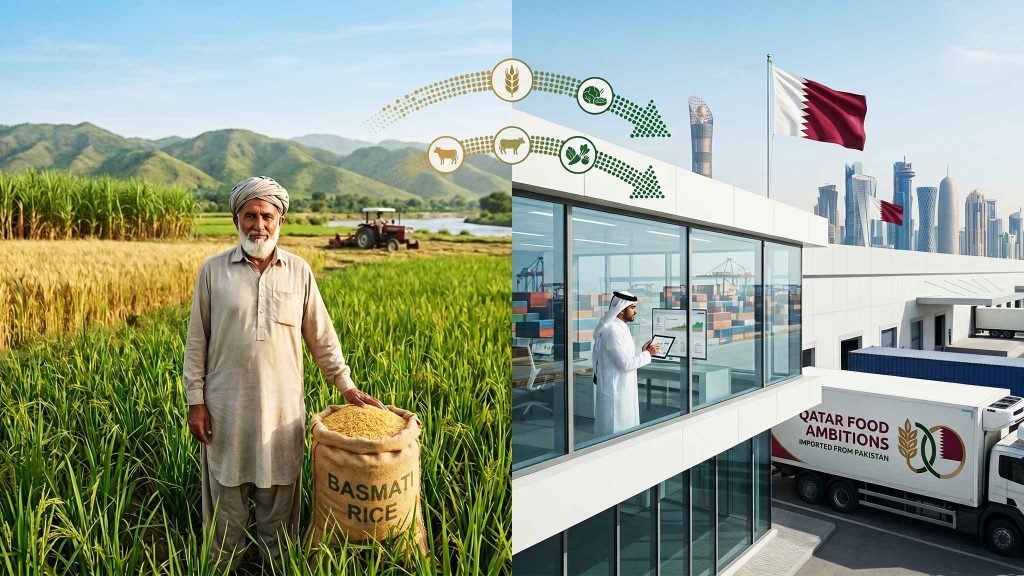
Pakistan, meanwhile, is one of the world’s top agricultural producers. It exports rice, meat, fruits, vegetables, seafood, and animal feed at scale, at competitive prices, and — critically — in formats that meet halal dietary requirements. Pakistan’s geographic proximity to the Gulf, its already-established trade corridor with Qatar, and the active support of the Pakistan Embassy’s Trade Section in Doha make it a natural strategic partner.
In 2024, Pakistan’s total exports to Qatar reached $157.19 million, with meat and offal leading at $32.39 million, edible vegetables at $27.85 million, cereals at $15.87 million, and fruits and nuts at $4.74 million — all categories that sit directly at the heart of Qatar’s import gaps.
Pakistan’s Export Performance to Qatar — 2024 Snapshot
Top Agri-Business Opportunities for Pakistan in 2025–2026
The Qatar National Food Security Strategy 2030 creates clear, funded demand in six core categories where Pakistani exporters are already competitive or can rapidly enter:
Halal-Certified Meat & Poultry — Qatar is a Muslim-majority country requiring full halal compliance across all meat and poultry imports. Pakistan’s halal processing industry is already well-established, making this the single highest-priority lane. Businesses that are not yet halal-certified should treat this as the first step before approaching any Qatari buyer.
Basmati Rice & Premium Grains — Basmati rice is a household staple across Gulf markets. Pakistan is one of the world’s top Basmati exporters, and Qatar’s cereal demand grows alongside its population. This is a high-volume, repeatable export with strong brand recognition.
Fresh & Frozen Vegetables — With vegetable self-sufficiency at only 39% in 2024 and winter-season concentration limiting year-round domestic supply, Qatar actively needs consistent imported vegetable volumes. Pakistani fresh and frozen vegetable exporters can fill this gap across all seasons.
Seafood & Aquaculture — Qatar’s seafood import ban on Pakistani products was recently lifted through active lobbying by the Pakistan Embassy in Doha. This is a brand-new lane to enter fast, before competition fills the shelf space.
Value-Added & Processed Foods — The national food security strategy 2030 explicitly targets development of Qatar’s food processing sector. Ready-to-cook meals, canned goods, and packaged foods from Pakistan can enter this emerging demand stream alongside bulk commodity exports.
Animal Feed Ingredients — Qatar’s livestock sector — currently over 1.4 million animals — requires consistent imported feed supply. Barley, maize, and other feed ingredients from Pakistan represent a durable, recurring demand channel.
The Bilateral Relationship: Where It Stands
The 2024 trade picture is one of significant imbalance — but that imbalance is itself the opportunity. Pakistan imported $3.73 billion from Qatar, primarily LNG, fertilizers, and petrochemicals. Pakistan exported $157.19 million back. That gap is enormous, and both governments are actively working to close it.
The Ministry of Commerce and Pakistan’s Special Investment Facilitation Council (SIFC) are deepening trade and investment ties with Qatar. The Pakistani Embassy’s Trade Section in Doha operates as an active facilitator — it was instrumental in lifting the seafood ban and is helping Pakistani businesses navigate certifications, buyer introductions, and market access challenges. A 6th Joint Ministerial Commission session is also scheduled, providing new institutional momentum for the bilateral relationship.
Qatar views Pakistan not as a one-time supplier, but as a strategic supply corridor — a long-term partner in its national food resilience architecture.
What Pakistani Exporters Must Do: A Practical Checklist
Obtain Halal Certification —Non-negotiable for meat, poultry, and processed foods entering Qatar.
Obtain a Certificate of Conformity (CoC) —Issued by a Qatar Ministry of Public Health (MoPH-FSD)-approved certification body. Required for all food imports into Qatar.
Meet Arabic-English Bilingual Labeling Requirements — Qatar mandates Arabic bilingual labeling on a wide range of food products. Non-compliance blocks market entry.
Invest in Cold Chain Infrastructure — Consistent, temperature-controlled logistics from farm to Doha port is essential for fresh produce. Cold chain gaps erode quality and buyer trust.
Register with Qatari Importers & Distributors — Establishing direct relationships with Doha-based distributors dramatically accelerates market penetration.
Explore the Mahaseel Platform — Qatar’s government-supported agricultural marketing platform represents a direct channel for Pakistani produce into the domestic market.
Leverage the Pakistan Embassy Trade Section in Doha — The Trade & Investment Section actively assists Pakistani exporters with buyer introductions, regulatory navigation, and market access issues.
Challenges to Navigate
No market opportunity is without friction. Pakistani exporters entering Qatar should plan for the following:
Competition is intense — EU countries exported approximately €650 million in agri-food products to Qatar in 2024. India and Turkey are also active competitors. Pakistan must compete on halal quality, supply consistency, and price rather than brand familiarity.
Qatar’s domestic capacity is growing — Qatar’s vegetable self-sufficiency is rising rapidly — it is projected to approach 70% or more during peak winter seasons by end-2026. Exporters in bulk vegetables should move quickly and diversify into value-added formats.
Logistics costs and connectivity —Direct freight connections between Pakistan and Doha remain limited. Better air and sea freight routes would significantly reduce logistics costs and improve freshness for perishables.
Regulatory compliance is the baseline — Qatar’s labeling, halal, and food safety certifications are non-negotiable prerequisites. Businesses that treat compliance as an afterthought will find themselves blocked at entry.
None of these challenges are structural barriers — they are operational ones. Pakistani businesses with the right strategy and certifications are well-positioned to compete and win.
Conclusion
The Qatar National Food Security Strategy 2030 is not a vague policy aspiration. It is a funded, official, government-backed, multi-initiative programme actively reshaping Qatar’s food import relationships right now. Rooted in the broader Qatar National Vision 2030 food security framework, this strategy signals a permanent structural shift in how food security in Qatar will be managed for the rest of the decade. For Pakistani agri-businesses — whether in meat processing, rice, seafood, vegetables, or animal feed — this represents one of the most concrete, accessible export opportunities in the Gulf today.
The window is open. The bilateral relationship is being actively supported at the government level. The certifications and compliance steps are clear. Pakistani exporters that move decisively — starting with halal certification, obtaining their Certificate of Conformity, and building direct relationships with Qatari importers — are positioned to secure long-term supply contracts and a lasting presence in one of the world’s most food-import-dependent economies.
Start today: get halal-certified, meet Qatar’s food safety standards, and reach out to Qatar-based importers. The opportunity is funded, it is strategic, and it will not stay this wide open indefinitely.
Frequently Asked Questions
Q1. What is the Qatar National Food Security Strategy 2030?
It is a seven-year, official, government-backed plan inaugurated in December 2024 by Qatar’s Prime Minister. The Qatar National Food Security Strategy 2030 encompasses 17 initiatives across three pillars — local production, strategic reserves, and international trade partnerships — and is fully aligned with Qatar National Vision 2030. Its core targets include achieving 55% vegetable self-sufficiency, 80% fish self-sufficiency, and maintaining 100% dairy and poultry self-sufficiency by 2030.
Q2. Why is this strategy important for Pakistani exporters?
Qatar imports over 90% of its food requirements — a structural dependency driven by limited arable land, scarce water, and a harsh climate. The Qatar food security strategy explicitly prioritises reliable international trade partnerships to bridge supply gaps. Pakistan is a large-scale halal agricultural exporter with competitive pricing and geographic proximity to the Gulf, making it a natural and high-potential long-term partner.
Q3. What food products is Pakistan currently exporting to Qatar?
Pakistan’s top food export categories to Qatar include meat and edible offal ($32.39M), edible vegetables ($27.85M), cereals including rice ($15.87M), and fruits and nuts ($4.74M). With the recent lifting of the seafood import ban, seafood and aquaculture products are now an emerging new export lane.
Q4. What is the size of the Pakistan–Qatar trade relationship?
In 2024, total bilateral trade reached $3.89 billion. Pakistan imported $3.73 billion — primarily LNG, fertilizers, and petrochemicals — while exporting $157.19 million. This significant trade imbalance represents a major growth opportunity for Pakistani food and agri-business exporters.
Q5. What are the top agri-business opportunities for Pakistan in 2026?
The strongest opportunities under the national food security strategy 2030 are in halal-certified meat and poultry, Basmati rice and premium grains, fresh and frozen vegetables (Qatar is at only 39% self-sufficiency), seafood (ban now lifted), value-added processed foods, and animal feed ingredients. These categories directly correspond to Qatar’s documented import gaps and strategy priorities.
Q6. What certifications are required to export food to Qatar?
Pakistani food exporters must obtain: (1) Halal certification for meat and applicable food products; (2) a Certificate of Conformity (CoC) from a Qatar MoPH-FSD-approved certification body; (3) Arabic-English bilingual product labeling; and (4) compliance with Qatar’s food safety and quality standards. Working with a Qatari import agent can help streamline this process.
Q7. How is the Pakistan government supporting this trade relationship?
The Ministry of Commerce and the Special Investment Facilitation Council (SIFC) are actively deepening trade and investment ties with Qatar. The Pakistan Embassy’s Trade & Investment Section in Doha provides direct support to exporters — it was instrumental in successfully lifting Qatar’s seafood import ban on Pakistani products, and continues to assist with buyer introductions and regulatory navigation.
Q8. Is Qatar open to long-term supply contracts with Pakistani companies?
Yes. Qatar is explicitly seeking reliable long-term supply partners — not spot importers — as part of its Qatar National Food Security Strategy 2030 official framework. Pakistani companies that can guarantee consistent quality, proper certifications, and scalable supply chains are well-positioned to negotiate long-term contracts with Qatari government agencies, supermarket chains, and private food distributors.
Passionate about global business, innovation, and making a real difference? Explore how you can contribute to AIBN’s mission. We’re building a team of dedicated professionals.
AIBN provides the expertise and network to connect you with the right global partners, unlocking new opportunities and accelerating your innovation’s journey.
If you have a great local idea and want to see it succeed worldwide, or if you share our passion for creating positive global change, we’d love to hear from you.
Explore AIBN’s comprehensive Insights Hub & gain the information you need to confidently navigate the global landscape & drive your innovation forward.