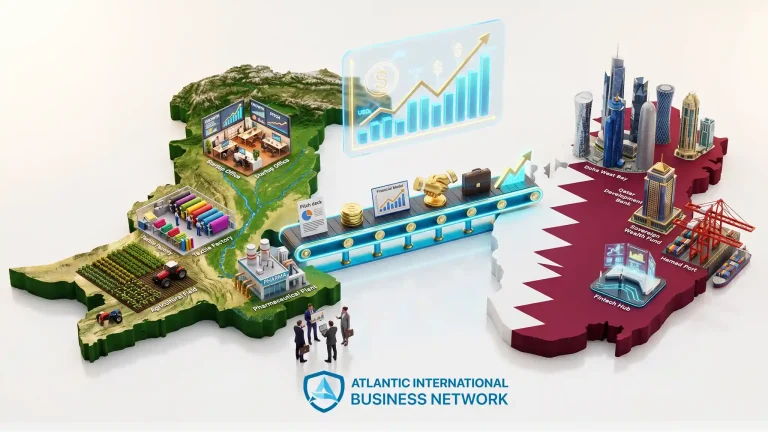



Qatar’s non-oil economy is growing faster than almost anyone predicted. If you’re a foreign investor, an SME, or a Pakistani entrepreneur exploring the Gulf, 2026 is the year to move — not watch from the sidelines. Qatar is actively building a new economic identity — one backed by billions in government spending, world-class infrastructure, and some of the boldest regulatory reforms the region has ever seen. The Qatar National Vision 2030 is not a mere promise of the future. It’s happening right now.
Why Qatar? Why 2026 Specifically?
Qatar is not just another oil-rich Gulf state. It’s actively building a new economic identity. Here’s what makes right now the right time:
- The infrastructure boom is over — airports, ports, smart cities, and digital networks are already built and running. You’re entering a market that’s ready to operate, not a construction site.
- The Third National Development Strategy (NDS3) targets 4% annual non-oil GDP growth in Qatar through 2030.
- The government has committed USD 17 billion in project spending for 2026 alone — USD 6B for healthcare, USD 5.3B for education, and USD 6B for municipal development.
- 100% foreign ownership in Qatar is now available across most sectors under Law No. 1 of 2019 — the old Qatari sponsor requirement is no longer required in most cases.
- The Qatar National Vision 2030 is not a mere plan for the future. It’s actively being executed with sovereign capital behind it.
Want to understand what this means practically? Read our Complete Guide to Company Setup in Qatar before making any decisions.
According to the IMF and S&P Global Market Intelligence, Qatar’s non-oil project pipeline through 2030 exceeds USD 150 billion — every dollar of which creates downstream demand for private-sector services, technology, and expertise.
Top Business Opportunities in Qatar in 2026
Not all sectors are equal. Here’s where the real money and government backing are flowing right now.
1. Technology, AI & Cybersecurity
- Qatar Science and Technology Park (QSTP) connects firms to six US university research centres and a dedicated tech venture fund.
- Businesses in AI automation, cloud computing, SaaS, and cybersecurity are in active demand for procurement.
- TASMU Smart Qatar Programme is an open pipeline for private tech firms — not future procurement, current contracts.
- Smart city development in Lusail City creates long-term IoT and infrastructure contracts.
- Tech startups receive up to USD 100,000 in non-equity grants through the Startup Qatar initiative.
Dubai Future Foundation’s 2025 GCC tech investment report confirms Qatar’s cybersecurity spending and AI procurement budgets are the fastest-growing in the region — outpacing the UAE and Saudi Arabia in year-on-year growth rate.
Note: Need help positioning your tech firm? Our Strategic Positioning service maps the exact entry path for you.
2. Healthcare & Life Sciences
- Hamad Medical Corporation and Sidra Medicine regularly partner with international private firms.
- Private clinics, mental health platforms, medtech startups, and healthcare software all have a clear runway.
- Public-private partnerships Qatar (PPP law 2020) allows contracts up to 30 years.
- Over 45 PPP projects are currently in the active pipeline.
- Medical tourism is a growing secondary market, boosted by partnerships with the Ministry of Public Health.
Aga Khan Health Services 2024 GCC expansion report highlights public-private partnerships in Qatar as the most accessible route for South Asian healthcare brands entering the Gulf, with Qatar’s PPP framework cited as a regional model.
Note: Our Investment & Funding Advisory team has helped multiple healthcare firms structure their Qatar entry correctly.
3. Logistics & Supply Chain
- 50% of cargo is now transshipment — Qatar has moved beyond a national port into a full regional trade hub.
- Freight forwarding, cold chain, warehousing, and last-mile delivery are all undersupplied.
- Ras Laffan Industrial City and Qatar Free Zone Authority (QFZA) provide zero-duty infrastructure.
- Food security mandates are driving demand specifically for temperature-controlled storage.
DP World identifies Hamad Port as the GCC’s most strategically positioned transshipment hub, citing integration with the Qatar Free Zone Authority (QFZA) as the key differentiator, making Qatar the preferred logistics gateway for South Asian exporters.
Note: See how our Market Entry & Expansion Strategy service helps you plug into this supply chain from day one.
4. Fintech & Financial Services
- The Qatar Financial Centre (QFC) runs a full fintech regulatory sandbox under English common law.
- 100% foreign ownership in Qatar with zero tax on foreign-sourced income — available through QFC.
- Over 25% of Qatar’s banking assets are held by Islamic banks — most Western digital finance products don’t serve them.
- That gap is a massive open door for Pakistani and UAE-based fintech founders.
- QFC licensing is one of the fastest setup routes — typically 4–6 weeks.
Note: Our Legal & Compliance Frameworks service helps fintech firms navigate QFC licensing without delays.
5. Tourism, Hospitality & Events
- Qatar has secured the Formula 1, the FIFA U-17 World Cup & the Asian Games (2030), and the Men’s Basketball World Cup (2027).
- PwC estimates that sports tourism contributes USD 1.6-2.4 billion to GDP per year.
- There is an increasing demand for boutique hotels, event companies, tour operators & luxury transport.
- Medical tourism is a new secondary market – Doha is becoming a regional hub for elective procedures.
- The government has announced tax-free holidays and 100% ownership incentives for hospitality investors.
Note: Engage the appropriate local partners with our Strategic Alliance Formation service.
6. Halal Food, Agri & Food Security
- Qatar Investment Authority (QIA) subsidiary Hassad Food Company is the leader in vertical farming, hydroponic systems & food processing investments.
- The halal food and agri sector in Qatar is especially appealing to Pakistani entrepreneurs, given Pakistan’s rich expertise in halal.
- According to TDAP data, halal food exports from Qatar to Pakistan increased by 34% YoY in 2024.TDAP data indicates that halal food exports from Qatar to Pakistan grew by 34% YoY in 2024.
- There are government grants and supply chain partnerships for qualifying agri-tech businesses.
TDAP‘s 2025 GCC Trade Opportunity Report identifies Qatar as Pakistan’s highest-growth bilateral trade partner in halal food, and specifically recommends Hassad Food Company partnerships as the fastest route to market for Pakistani agri-food businesses.
Note: Read our dedicated blog: Qatar’s National Food Security Strategy 2030 — it covers exactly what Hassad is trying to fill with private-sector partners.
Market Entry Routes: QFC vs QFZA vs Mainland
| Route | Best For | Key Benefit | Tax Rate |
| QFC | Fintech, consulting, tech, professional services | English law, sandbox, 100% ownership | 10% on local profits only |
| QFZA (Free Zone) | Logistics, manufacturing, port-adjacent businesses | 0% corporate tax up to 20 years, no customs duties | 0% in zone |
| Mainland (MOCI) | Retail, construction, hospitality, gov contracts | Full access to Qatari consumers and government tenders | 10% corporate tax |
Key things to know about setup:
- The MOCI Ministry of Commerce and Industry Qatar Single Window portal has cut registration times by 45%.
- Most SMEs complete setup in 4–12 weeks, depending on the route.
- The banking setup is the most time-consuming step — plan for it early and separately.
Pakistan–Qatar Business Opportunities: A Natural Partnership
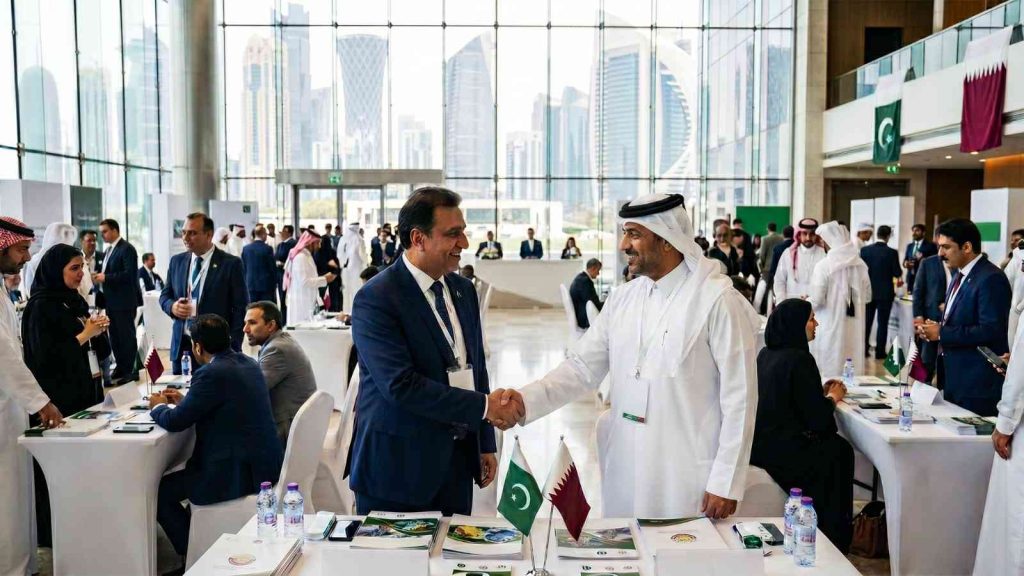
Pakistan’s business expansion in Qatar is one of the most underused opportunities in the Gulf right now. SBP‘s 2025 External Sector Report confirms that Pakistan–Qatar bilateral trade crossed USD 2.5 billion in 2024 and recommends Qatar as the primary outbound vehicle for Pakistani businesses seeking Gulf market access.
Here’s why the fit is so strong:
- Pakistan’s expertise in halal food, construction, IT services, and textiles aligns closely with Qatar’s highest-demand sectors.
- A large Pakistani diaspora in Qatar creates trust networks that significantly reduce market-entry friction.
- Pakistani IT firms can register through the Qatar Financial Centre (QFC) and serve both Qatari and regional clients — with zero tax on foreign-sourced income.
- Agri-tech companies can align directly with Hassad Food Company supply chains under Qatar’s food security mandate.
- Qatar international business partnerships 2026 are increasingly driven by South Asian bilateral joint ventures under NDS3.
- The SBP 2025 External Sector Report confirms that Pakistan–Qatar bilateral trade crossed USD 2.5 billion in 2024.
For partnership structuring, our Joint Venture Facilitation and B2B Matchmaking & Networking services connect Pakistani businesses directly with verified Qatari counterparts.
Best Small Business Ideas in Qatar 2026
- Digital Marketing Agency — Every Qatari SME needs SEO, social media, and paid ads—low overhead, high demand, and very scalable.
- Business Setup Consulting — As foreign direct investment in Qatar surges, investors need on-the-ground guides. See our Qatar Business License Guide 2026.
- IT Support & Cloud Services — SMEs constantly outsource their IT: recurring revenue, low capital to start.
- B2B Matchmaking & Events — Use our Exhibition & Event Management and Conference Organisation services to build your presence fast.
- Cloud Kitchen/Food Delivery — Qatar’s food delivery market continues to grow. Lower risk than a full restaurant setup.
- Translation & PRO Services — Qatar’s multicultural workforce creates constant, repeat demand for these services.
- Halal Food Export & Distribution — Align with Hassad Food Company supply chains. Full context in our Qatar Food Security Strategy blog.
- Consultancy & Advisory Firm — Read our guide: Consultancy Business Plan for Global Expansion.
Key Things to Know Before You Enter Qatar’s Market

Qatar rewards the well-prepared. These are the things that separate successful entries from expensive mistakes:
- Choose your legal structure first (QFC, QFZA, or Mainland) — wrong choice costs months. Validate with our Feasibility Studies before committing capital.
- Qatarisation hiring quotas are mandatory — build them into your cost model from day one.
- Start government relationship-building 12–18 months before any tender — waiting for the RFP is too late.
- Qatar’s LNG and energy diversification is a decade-long structural shift, not a short cycle.
- Qatar Energy supply chain access delivers consistent procurement pipelines — our Distribution Agreement Brokering can open these doors.
- Build cross-cultural skills before you arrive with our International Negotiation Skills and Cultural Competency Programs.
Abu Dhabi Investment Office’s (ADIO) 2025 GCC Investment Climate Report highlights Qatar as the Gulf’s most improved business environment for foreign SMEs, citing the MOCI (Ministry of Commerce and Industry, Qatar) Single Window reforms as a regional benchmark for businesses from Pakistan and South Asia.
Conclusion
2026 Qatar is not a market to watch; it’s a market to enter. 100% foreign ownership, no personal income tax, a thriving non-oil economy & more than USD 17 billion in government project spending this year alone – the window for first-mover advantage is now open. From foreign investors to SMEs and Pakistani entrepreneurs, AIBN can guide you through Qatar’s terrain, select the appropriate structure, and get you off to a flying start. Ready to move? Check out AIBN’s services or schedule a free consultation today.
Frequently Asked Questions
Can foreigners own 100% of a business in Qatar?
Yes. Under Law No. 1 of 2019, 100% foreign ownership is permitted across most commercial activities. The Qatar Financial Centre (QFC) and Qatar Free Zone Authority (QFZA) also guarantee full foreign ownership. A few strategic sectors — banking, insurance, defense — still retain mandatory Qatari shareholding.
What are the top business opportunities in Qatar in 2026?
The top business opportunities in Qatar are technology and AI, healthcare, logistics, fintech, tourism, and the halal food and agri sector. These align directly with NDS3 targets and carry the strongest government procurement budgets.
How long does it take to set up a company in Qatar?
Through the QFC: 4–8 weeks. Through the MOCI Ministry of Commerce and Industry Qatar mainland route: 8–12 weeks. Our Complete Guide to Company Setup in Qatar walks through every step and the associated costs.
Is Qatar a good market for Pakistani businesses?
Absolutely. Pakistan’s business expansion in Qatar is a natural fit — its strengths in halal food, IT, construction, and textiles closely align with Qatar’s highest-demand sectors. Start with our Strategic Startup Expansion into GCC Markets Guide.
What is the corporate tax rate in Qatar?
No personal income tax. Corporate tax is 10% for foreign-owned mainland entities. QFC entities pay 10% only on locally sourced profits — zero on foreign-sourced income. Free zone businesses enjoy 0% corporate tax for up to 20 years.
How does the Qatar Investment Authority (QIA) help foreign investors?
The Qatar Investment Authority (QIA) is Qatar’s sovereign wealth fund and an active co-investor in strategic sectors. Aligning with QIA-linked entities, such as Hassad Food Company, dramatically accelerates market credibility. Our Investor Matching & Relations service connects you with the right institutional partners.